

235 ships exceeding 270 billion! New energy ships become the leading ships in the new shipbuilding market
2025-08-04 14:10
In the first half of 2024, a total of 235 new ship orders using alternative fuels were signed worldwide, with a total amount exceeding 278.4 billion yuan, and the market heat continued to rise. Driven by the dual pressures of carbon neutrality and environmental regulations, more and more shipowners are considering alternative fuels as a core consideration for new ship investments. Green transformation is accelerating, and alternative fuel ships are becoming the main players in the global new shipbuilding market.
According to Clarkson's latest statistics, out of a total of 647 new ship orders with a total tonnage of 37 million worldwide in the first half of this year, as many as 235 ships with a total tonnage of 20.6 million were alternative fuel vessels, accounting for 55.5%, surpassing the 46% for the whole of last year and the historic 54.6% for the whole of 2022. In terms of order value, the total global investment in new shipbuilding in the first half of this year was 67.5 billion US dollars, and the value of orders for alternative fuel ships was 38.7 billion US dollars (approximately 278.42 billion yuan), a year-on-year decrease of 33%, accounting for 57.3% of the total.
This year's alternative fuel ship orders include 102 LNG powered ships with a total tonnage of 13.3 million, 50 methanol powered ships with a total tonnage of 6 million, 14 LPG powered ships with a total tonnage of 600000, and 69 battery/hybrid propulsion ships with a total tonnage of 1.1 million.
In recent years, the proportion of alternative fuel vessels in new ship orders has been steadily increasing, rising from only 8.2% in 2016 to 32% in 2021, and reaching an all-time high of 54.6% in 2022. After falling to 41% in 2023, it returned to 46% in 2024.
In terms of shipyard countries, Clarkson's data shows that the vast majority of alternative fuel new ship orders in June 2025 were undertaken by Korean shipyards, with a total of 14 ships totaling 905000 CGT, accounting for 63.8% of the June 2025 alternative fuel new ship orders based on CGT, ranking first in the world in terms of order volume. Among them, there are 12 LNG dual fuel ships with a CGT of 832000 and 2 LPG dual fuel ships with a CGT of 74000.
At the same time, Chinese shipyards received a total of 12 orders for 485000 CGT alternative fuels in June, with a market share of 34.2%. Among them, there are 10 methanol dual fuel ships with a total of 455000 CGT, 1 LNG dual fuel ship with 25000 CGT, and 1 battery/hybrid ship with 6000 CGT.
According to Clarkson's data, overall by tonnage, the proportion of ships in the operating fleet that can use alternative fuels or propulsion devices has increased to 8.5%, up from 2.6% in 2017 and 6.5% at the beginning of 2024. Among the current total of 2453 alternative fuel ships, there are 1421 LNG powered ships, 66 methanol powered ships, 141 LPG powered ships, 715 battery/hybrid propulsion ships, and an additional 263 ships that use other fuels.
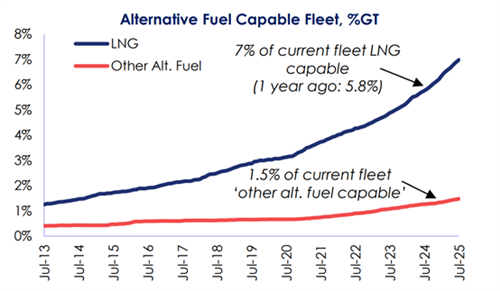
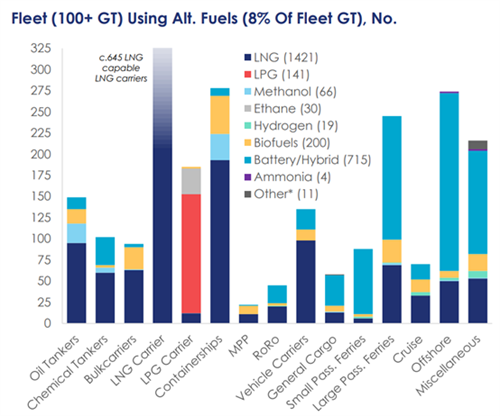
In the handheld orders, the proportion of alternative fuel vessels reached 52.4%, higher than 10.9% in 2017 and 48.5% in early 2024. Calculated by tonnage, 36.4% of the orders held are LNG powered ships (1007), 10.6% are methanol powered ships (344), and 2.0% are LPG powered ships (143); In addition, about 3.2% (approximately 544 vessels) are using other alternative fuels, including 40 hydrogen fuel vessels, 66 ethane fuel vessels, 44 ammonia fuel vessels, 19 biofuel vessels, and 504 battery/hybrid propulsion vessels. The total number of orders for alternative fuel vessels is 2038.
With the continuous expansion of fuel selection in the future, the number of reserved ships for alternative fuels is also increasing. At present, there are 580 LNG ready ships in the operating fleet, and there are still 160 orders in hand; At the same time, there are 303 ammonia ready ships, 630 methanol ready ships, and 15 hydrogen ready ships in the hand-held orders.
At the same time, the latest statistics from DNV's Alternative Fuel Insight (AFI) data platform indicate that in the first half of 2025, new orders for alternative fuel vessels reached 151 vessels with a total tonnage of 19.8 million tons. Although the number of vessels is slightly lower than the 179 vessels in the same period of 2024, the total tonnage has significantly increased, with a year-on-year growth of 78%. This is mainly due to container ship orders, but there are also significant orders in the fields of bulk carriers, oil tankers, and passenger roll on/roll off ships.
DNV pointed out that this concentration trend indicates that some sectors in the industry that are most affected by market fluctuations and have the most complex operations are leading the transformation, which further confirms that alternative fuels are no longer a peripheral strategy, but a mainstream investment decision.
LNG is clearly the preferred fuel, with a total of 87 new LNG powered ships with a total tonnage of 14.2 million tons ordered so far in 2025. LNG fuel still dominates the container ship industry, reaching a total of 13.6 million tons for 81 ships. Methanol also showed a strong momentum, with 40 new orders of 4.6 million gross tons in the field of container ships, roll on/roll off passenger ships, oil tankers, offshore factory ship and motor carriers.
Although ammonia fuel and hydrogen fuel are still niche, continued order activity indicates early confidence in their long-term potential in the industry. Three ammonia fueled vessels (totaling 37000 gross tons) have been added to the handheld orders, mainly in the fields of oil tankers and general cargo ships. Hydrogen fuel vessels have also returned to the market, with four (114000 total tons) currently under construction.
In addition, supportive infrastructure is also developing in sync with ship investment. In the first half of 2025, a total of 13 new LNG refueling ship orders were signed, with February being the strongest month for orders, reaching 8 ships. This growth reflects the steady coordination between orders for alternative fuel vessels and the logistics required for large-scale applications, especially LNG, where refueling capacity has become a key driving factor for continued promotion.
DNV Maritime CEO Knut Ø rbeck Nilssen commented, "We are seeing a broader transformation across the industry. The energy transition is no longer solely driven by pioneers, but is now being shaped by a second wave of ship owners who are integrating alternative fuels and technologies into their core strategies. Even as the new shipbuilding market slows down, fuel choices are diversifying and decarbonization is becoming integrated into daily decisions. We expect fuel selection and energy efficiency investments to accelerate as regulatory frameworks become clearer in the next 4 to 10 months
Related News

Address: No. 6, Xingyuan Avenue, Rucheng Street, Rugao City, Jiangsu Province
Tel: 86-513-87268999、86-513-7268666
Fax: 86-513-87268998
Email: info@ntlw.com
WeChat:15335077201

WeChat Official Account
Video account
Douyin account
Copyright © 2025 Nantong Liwei Machinery Co., Ltd.丨Powered by:www.300.cn丨SEO