

8 vessels for $800 million! CIMC Raffles to receive a large order for car carriers
2022-07-01 09:00
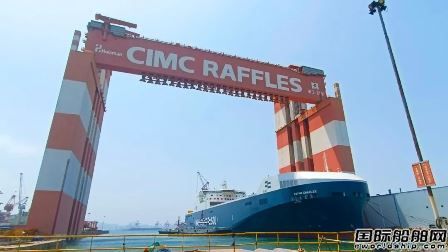
The booming car carrier market has finally prompted Wallenius Wilhelmsen, the world's largest car carrier company, which had previously misjudged the market, to return to the newbuilding market and order eight large vessels. Chinese shipbuilders are expected to be the biggest winners in this wave of car carrier orders.
According to TradeWinds, Wallenius Wilhelmsen is in close talks with CIMC Raffles to order 4+4 9,000-car-capacity dual-fuel car carriers, expected to be delivered successively after 2024. Industry insiders estimate that each vessel will cost around US$100 million, with a total value of US$800 million (approximately RMB 5.359 billion) for all eight vessels. This will be one of the world's largest car carriers. Clarkson's data shows that most of the current global car carrier backlog is around 7,000 car capacity, with the largest being the 8 vessels of 9,100 car capacity ordered by Hoegh Autoliners from China Merchants Heavy Industry (Jiangsu).
If this order is finalized, it will be Wallenius Wilhelmsen's first order in this wave of car carrier orders. However, Wallenius Lines did order two 6,500-car-capacity dual-fuel car carriers from CIMC Raffles last year.
Wallenius Wilhelmsen is understood to be a privately owned Norwegian/Swedish shipping company established in 1999, jointly owned by Wallenius Lines and Wilh. Wilhelmsen. As the world's largest car carrier company, Wallenius Wilhelmsen currently operates 130 car carriers and 8 car terminals, employing 8,200 people in 29 countries and regions.
In 2020, the impact of the pandemic caused a sharp drop in automobile seaborne trade. Lockdown measures severely impacted automobile production and sales, directly leading to a decline in seaborne exports. Wallenius Wilhelmsen then predicted that the car carrier market would remain sluggish for a long time and quickly took action, choosing to idle at least 10 car carriers in the second quarter of 2020. This proved to be a costly mistake, as the rebound in car carrier demand in the third quarter of the same year took the market by surprise.

After years of downturn, the car carrier market rebounded strongly last year and ushered in a new wave of orders. From the beginning of last year to the present, the number of new car carrier orders has reached 66, while the cumulative number of new orders from 2016 to 2020 was only 20.
Meanwhile, rising steel prices, global inflation, and limited shipyard capacity have driven up the price of new car carriers. As a specialized vessel type, car carriers are more expensive than other more common general-purpose vessels. As of now, the price of new 7,000-standard-car-capacity car carriers has increased by 30% from the beginning of 2021, nearing US$90 million; during the same period, the price of 5-year-old 6,500-car-capacity second-hand vessels has increased by 52% according to Clarkson. At the same time, shipyard capacity is tightening, and most shipyards' new orders are scheduled until 2025.
Chinese shipbuilders are the biggest winners in this wave of car carrier orders. According to Clarkson's data, Chinese shipbuilders have received a total of 51 car carrier orders since last year, far exceeding Japanese shipbuilders (13 vessels) and South Korean shipbuilders (2 vessels). In terms of shipyards, CIMC Raffles ranks third globally in terms of car carrier backlog, with a total of 9 vessels, second only to China Merchants Industry Nanjing Jinling (11 vessels) and China Merchants Industry Weihai Jinling (10 vessels).
Clarkson's data shows that due to market imbalance, surging demand, and port congestion, car carrier freight rates have continued to rise from a low of US$10,000 per day in mid-2020. By April this year, the daily charter rate for a one-year lease of a 6,500-car-capacity car carrier has soared to a record high of US$55,000, a 450% increase in freight rates.
Data shows that there are currently about 700 car carriers globally, which is insufficient to meet the rapidly growing market demand and increasingly stringent environmental regulations. Some car carriers believe that with the implementation of new energy efficiency regulations, it is necessary to vigorously promote green newbuildings to meet demand. Market analysis agencies say that the global market needs to build another 200 LNG-powered car carriers to meet both emission requirements and growing market demand.
Related News

Address: No. 6, Xingyuan Avenue, Rucheng Street, Rugao City, Jiangsu Province
Tel: 86-513-87268999、86-513-7268666
Fax: 86-513-87268998
Email: info@ntlw.com
WeChat:15335077201

WeChat Official Account
Video account
Douyin account
Copyright © 2025 Nantong Liwei Machinery Co., Ltd.丨Powered by:www.300.cn丨SEO