

70 days, over 600 billion yuan in orders! This shipbuilding giant single-handedly confronts China
2024-03-27 09:00

Securing four more VLCC orders, exceeding 60 billion yuan in orders this year, a new high in nearly three years—the order "surge" of HD Hyundai, South Korea's largest shipbuilding group, continues. This shipbuilding giant is single-handedly competing against the entire Chinese shipbuilding industry.
New high for single-ship price! Hyundai Heavy Industries wins four VLCC orders
On March 12, HD Hyundai (formerly Hyundai Heavy Industries Group), the shipbuilding business holding company of HD Korea Shipbuilding & Offshore Engineering, announced that it had signed a contract with a European shipowner for the construction of four 300,000-ton very large crude carriers (VLCCs), with a total contract value of approximately 688 billion won (approximately US\$522 million).
These four new vessels will be built by Hyundai Samho Heavy Industries located in Yeongam County, South Jeolla Province, and are scheduled for delivery before December 2027.
HD Korea Shipbuilding & Offshore Engineering did not disclose specific information about the shipowner, but according to foreign media reports, the order came from Israeli shipowner Ray Car Carriers. This company previously ordered up to 10 LNG dual-fuel car carriers from Hyundai Samho Heavy Industries and Hyundai Mipo Dockyard, and is the only shipowner in this round of car carrier orders that chose only Korean shipbuilders to build new ships.
It is worth mentioning that the price of a single VLCC in this batch is 172 billion won (approximately US\$130.5 million), exceeding the US\$129 million single-ship price of the VLCC signed by HD Korea Shipbuilding & Offshore Engineering with an Oceania shipowner at the end of February, once again setting a new record since the outbreak of the 2008 international financial crisis.
For reference, Clarksons' data shows that the current price of a new 315,000-320,000 DWT VLCC is US\$128.5 million, a 7% increase compared to US\$120 million in the same period last year.
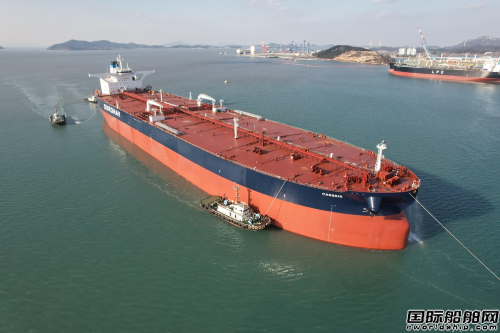
As of now, Hyundai Samho Heavy Industries has received orders for 16 new vessels this year, including 6 LNG carriers, 2 VLGCs, 2 VLACs, and 6 VLCCs, with a total value of US\$2.82 billion, reaching approximately 88% of its initial target of US\$3.2 billion in orders.
At the same time, HD Korea Shipbuilding & Offshore Engineering has received orders for 69 vessels (units) of marine equipment this year, with a total contract value of US\$8.38 billion (approximately 60.11 billion yuan), completing approximately 62% of its annual order target of US\$13.5 billion. This includes 6 large LNG carriers, 17 VLGCs/VLACs, 4 LPG carriers, 26 product tankers, 1 VLEC, 6 VLCCs, 3 crude oil tankers, 2 LCO2 carriers, 2 car carriers, 1 offshore platform topside module, and 1 FSRU.
South Korean industry insiders said that while the global new ship order market is gradually cooling down, HD Korea Shipbuilding & Offshore Engineering has achieved excellent results by focusing on selective order taking. In the first 70 days of this year, the cumulative order value has already exceeded the first-quarter order value of the past three years. If the current trend continues, the company's annual order value is expected to exceed US\$20 billion for four consecutive years since 2021.
In the first quarter of 2021, 2022, and 2023, HD Korea Shipbuilding & Offshore Engineering received orders of US\$5.57 billion, US\$7.68 billion, and US\$7.3 billion, respectively. In the past three years, the company's highest annual order value was in 2022, with 196 new vessels ordered and a total contract value of approximately US\$24 billion. However, the company's order value in the first quarter of this year has already surpassed that of the same period in 2022, so the possibility of exceeding US\$20 billion in order value for four consecutive years is very high.
7 billion: 8.5 billion! HD Korea Shipbuilding & Offshore Engineering single-handedly confronts China
Having secured sufficient workload, HD Korea Shipbuilding & Offshore Engineering has adopted a "selective order-taking" strategy since last year, focusing only on shipowners who offer high ship prices. The company believes that compared to 2022, the global new ship order volume will slow down in 2023. Instead of engaging in an order-taking battle regardless of cost, it is better to further increase ship prices through selective order-taking.
Clarksons' data shows that the global new ship order investment in 2023 was US\$118.3 billion, which is not only less than US\$138.6 billion in 2022 but also lower than US\$119 billion in 2021. However, despite the decrease in orders, prices for all ship types remain on an upward trend. At the end of 2023, the Clarksons Newbuilding Price Index reached 178 points, an increase of nearly 10% compared to 162 in the same period of 2022.
Since the beginning of this year, new ship prices have continued to rise. The Clarksons Newbuilding Price Index at the end of February this year was 181.45 points, up 18.6 points year-on-year and up 0.18 points month-on-month. Among them, HD Korea Shipbuilding & Offshore Engineering is leading the upward trend of global new ship prices with its continuously record-breaking order performance.
In February this year, HD Korea Shipbuilding & Offshore Engineering received an order for a 174,000 cubic meter LNG carrier from Greek shipowner Capital Group, with a historically high single-ship price of US\$270 million for the first time; the single-ship price of the 7,500 CEU car carrier received from Ray Carriers also reached a record high of US\$134 million.
On March 6, HD Korea Shipbuilding & Offshore Engineering received an order for a floating liquefied natural gas storage and regasification unit (LNG-FSRU) from Japan's Mitsui O.S.K. Lines, priced at approximately US\$363 million, also the highest globally. Considering that the current market price of a conventional LNG carrier is US\$265 million, the FSRU received this time is a high-value-added product that is nearly US\$100 million more expensive than an LNG carrier.
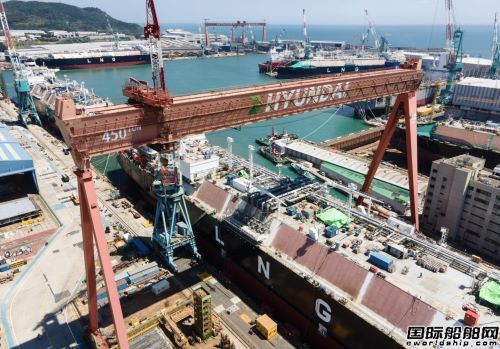
South Korean industry insiders said that the Chinese shipbuilding industry, with its price competitiveness, has accelerated its pace of catching up with South Korea in the liquefied gas carrier market, following bulk carriers, tankers, and container ships. In response, the South Korean shipbuilding industry continues to receive orders from shipowners who want to build high-specification ships, based on its high technological capabilities and quality.
Korean media pointed out that in December last year, during the 2023 China International Maritime Exhibition, China Shipbuilding Group officially received an order for 12+8 of the world's largest 10,800-car-capacity LNG dual-fuel powered car carriers. The final charterers of these car carriers are all Hyundai Glovis, a subsidiary of South Korea's Hyundai Motor Group. It is reported that the single-ship price of these PCTCs is US\$122 million, which is US\$12 million lower than the 7,500-car car carrier received by HD Korea Shipbuilding & Offshore Engineering.
South Korean industry insiders said that in the global new ship market, HD Hyundai's position is significantly different from other shipbuilding companies. Clarksons' data shows that in January-February this year, the global new ship investment amounted to US\$20.17 billion, and HD Hyundai's order value reached US\$7 billion, accounting for 34.7%. Considering that the order value of the South Korean shipbuilding industry during the same period was US\$9.03 billion, accounting for 44.8% of the global market, and the order value of the Chinese shipbuilding industry was US\$8.54 billion, accounting for 42.3% of the global market, HD Hyundai is actually competing with the entire Chinese shipbuilding industry in the global shipbuilding market.
A relevant person from HD Hyundai said: "Since the beginning of this year, the company has continuously received inquiries for orders of various ship types, including environmentally friendly ships. The company will focus on high value-added ship orders and strive to strengthen profitability."
Related News

Address: No. 6, Xingyuan Avenue, Rucheng Street, Rugao City, Jiangsu Province
Tel: 86-513-87268999、86-513-7268666
Fax: 86-513-87268998
Email: info@ntlw.com
WeChat:15335077201

WeChat Official Account
Video account
Douyin account
Copyright © 2025 Nantong Liwei Machinery Co., Ltd.丨Powered by:www.300.cn丨SEO