

Chinese shipbuilders win 70% of orders! Global new shipbuilding orders hit a new high
2024-12-23 09:00
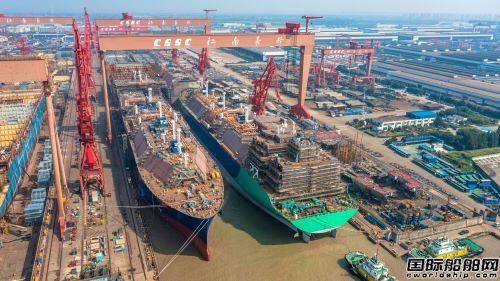
The global shipbuilding industry is experiencing a new round of cyclical growth, and new ship orders this year are expected to reach their highest level since 2007. Chinese shipbuilders have performed particularly well, securing nearly 70% of global orders, further consolidating their leading position in the global market.
Clarksons, in its recently released report, stated that 2024 is a year of very strong demand for newbuilds. In the first 11 months, new ship orders reached 2,159 vessels with 152.1 million DWT and 60.3 million CGT, 71% higher than the average of the past ten years. The total number of new ship orders for the whole year is expected to reach the highest level since 94 million CGT in 2007.
The report points out that, unlike previous years where strong demand for a single ship type drove a surge in overall order volume, this year the new ship order volume in most ship types is far higher than the average of the past ten years. For example, in 2007 and 2013, bulk carriers, as the main ship type, accounted for 40% of the year's new ship orders (in terms of CGT), especially in 2007, bulk carrier new ship orders were about six times the ten-year average; this year, the two ship types with the most orders are container ships and tankers, accounting for 28% and 24% respectively. Orders for other ship types are also strong, generally exceeding the ten-year average by 50-180%.
Overall, the strong performance of multiple ship type markets, fleet renewal needs, and competition for available shipyards over longer delivery cycles have all driven the significant growth in new ship orders in 2024.
It is worth mentioning that the leading position of Chinese shipbuilders in the global shipbuilding industry has been further strengthened. In the first 11 months of this year, Chinese shipbuilders have received a total of 1,518 new ship orders, totaling 115.9 million DWT and 41.8 million CGT, representing a year-on-year increase of 53% in terms of DWT and 57% in terms of CGT. Chinese shipbuilders accounted for 69% of the global new ship orders of 60.3 million CGT, up from 59% last year.

According to Clarksons' statistics, in the first 11 months of this year, new orders for container ships increased to 3.9 million TEU, only 6% lower than the record 4.5 million TEU in 2021 and 128% higher than the average of the past ten years. In the tanker sector, new orders for crude oil tankers and product tankers have increased significantly, reaching 26.7 million and 19.1 million DWT respectively, representing increases of 59% and 167% compared to the ten-year average; new orders for chemical tankers increased to 4.8 million DWT, a 148% increase compared to the ten-year average.
In the liquefied gas sector, driven by orders for very large ammonia carriers (VLAC) and very large ethane carriers (VLEC), LPG ship new orders hit a new high, totaling 9.6 million cubic meters in the first 11 months, 31% higher than the record level for the whole of last year. With the completion of the signing of all 68 orders in the second phase of Qatar's "100-ship plan", new orders for LNG ships this year increased to 15.9 million cubic meters, setting a new historical high, although still 44% lower than the peak in 2022.
On the other hand, due to high ship prices and limited available shipyards, new orders for bulk carriers in the first 11 months decreased by 19% year-on-year to 38.8 million DWT, but still 10% higher than the ten-year average. Orders for ro-ro ships and ferries remained weak, 53% lower than the ten-year average, mainly due to weak market conditions and fuel decision challenges under environmental regulations.
Along with the continued growth in new ship orders, newbuilding prices have also remained high. The Clarksons Newbuilding Price Index currently stands at 189 points, a 6% increase from 178 points at the beginning of 2024 and a 51% increase compared to the recent low of 125 points in November 2020.
As a result, new shipbuilding investment this year is also expected to set a new record. In the first 11 months, the total value of new ship orders has reached US$188.5 billion (approximately RMB 1.37 trillion), more than double the ten-year average, and is expected to become the second highest level in history in nominal terms, second only to the peak of US$264.3 billion in 2007.
As of early December this year, global order backlog increased to 5,533 vessels with 355.8 million DWT and 153.6 million CGT, representing increases of 24% and 16% respectively compared to the beginning of the year. Among them, Chinese shipbuilders' order backlog increased to 3,372 vessels with 233 million DWT and 87.7 million CGT, a 33% increase compared to 65.9 million CGT at the end of 2023, and its global share increased from 50% at the end of last year to 57%; in contrast, the order backlogs of Japanese and South Korean shipbuilders have declined to varying degrees, with South Korean shipbuilders' order backlog falling from 38.8 million CGT to 38 million CGT, and Japanese shipbuilders' from 14.4 million CGT to 12.7 million CGT.
In the first 11 months, global new ship deliveries totaled 1,648 vessels with 81.4 million DWT and 36.8 million CGT. The total delivery volume for the whole year is expected to reach 89 million DWT and 40.4 million CGT, the highest level in the past ten years. At the same time, Clarksons expects new ship deliveries to further increase to 43.6 million CGT next year and 43.8 million CGT in 2026.
Related News

Address: No. 6, Xingyuan Avenue, Rucheng Street, Rugao City, Jiangsu Province
Tel: 86-513-87268999、86-513-7268666
Fax: 86-513-87268998
Email: info@ntlw.com
WeChat:15335077201

WeChat Official Account
Video account
Douyin account
Copyright © 2025 Nantong Liwei Machinery Co., Ltd.丨Powered by:www.300.cn丨SEO