

15,000 new hires! 8% salary increase! The labor shortage at the five major shipyards is easing.
2025-02-27 17:41
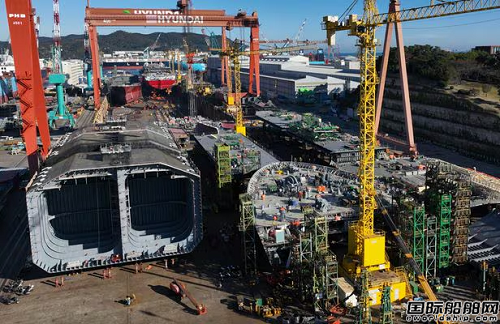
With 15,000 new workers added annually and increased salary growth for subcontracted workers! Thanks to the collaborative efforts of the South Korean government and shipbuilding companies, the South Korean shipbuilding industry's labor market is experiencing positive changes, effectively alleviating the shipyard's "labor shortage."
Recently, the South Korean Ministry of Employment and Labor held a one-year report meeting on the "Win-Win Agreement to Improve the Dual Structure of the Shipbuilding Industry Labor Market" at Samsung Heavy Industries' Pangyo R&D Center in Seongnam, Gyeonggi-do. Representatives from five major South Korean shipyards—HD Hyundai Heavy Industries, Samsung Heavy Industries, Hanwha Ocean, HD Hyundai Mipo Dockyard, and HD Hyundai Samho—along with subcontractor representatives and experts, attended the meeting to conduct an interim review of the agreement's implementation.
The five major shipyards positively assessed the results achieved in the year since the agreement was signed, including increased wage growth for subcontracted employees and partial alleviation of labor shortages. They also agreed that future efforts should focus on narrowing the income gap between shipyard and subcontracted employees, strengthening domestic skilled labor training, and minimizing multi-tier subcontracting.
Park Jong-sik, a member of the South Korean "Symbiotic Agreement Body for the Shipbuilding Industry" and a PhD from the Korea Labor Institute, explained the agreement's implementation over the past year at the report meeting. He stated that due to the timely and effective payment of appropriate project funds to subcontractors by shipyards, the wage growth rate for subcontracted employees has increased from 6.02% in 2022 to 7.51% in 2023. The five major shipyards have all implemented a pre-deposit system for settlement payments to prevent wage arrears for subcontracted employees, and they have increased contributions to the joint labor welfare fund from 1 billion won to 2 billion won, narrowing the income gap between shipyard and subcontracted employees to some extent.
Park Jong-sik also stated that the labor shortage in the South Korean shipbuilding industry has been partially alleviated. As of the end of last year, through the recruitment of domestic young employees and the large-scale introduction of foreign workers, the number of employees at the five major shipyards and their partner companies (subcontractors) has increased by approximately 15,000 compared to the end of 2022, representing a year-on-year increase of 21.3%. The extremely severe labor shortage has been alleviated to some extent.
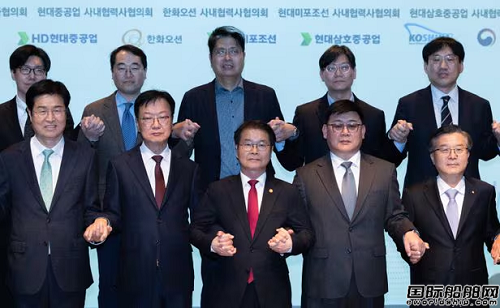
Professor Jeong Heung-jun of Seoul National University of Science and Technology stated: "The win-win agreement alone cannot solve all the problems in the shipbuilding industry, but after the agreement was signed, all parties worked hard to overcome the limitations of a one-time agreement and have operated stably for one year, which is very rare."
Jeong Heung-jun stated that after the agreement was signed, the labor shortage in the shipbuilding industry has been alleviated, the five major shipyards have increased their support for subcontractors, and the wages of subcontracted employees have also been increased, which is commendable. In the future, all relevant parties should continue to work on strengthening domestic skilled labor training, expanding the coverage of fair labor contracts, minimizing multi-tier subcontracting, improving the systematization of foreign worker utilization, narrowing the income gap between shipyard and subcontracted employees through subsidies, and establishing a wage system centered on skills and expertise.
Lee Jeong-sik, South Korea's Minister of Employment and Labor, stated: "The government will coordinate all parties to achieve successful win-win cooperation and create a sustainable shipbuilding industry ecosystem. We hope that the achievements of the shipbuilding industry's win-win agreement will serve as a milestone for win-win models for other industries and regions, and also serve as a basis for expanding the middle-class social dialogue."
Last February, the South Korean Ministry of Employment and Labor and Ulsan City signed the "Win-Win Agreement to Improve the Dual Structure of the Shipbuilding Industry Labor Market" at HD Hyundai Heavy Industries. This agreement was signed voluntarily by relevant shipbuilders and subcontractors based on a consensus between large shipyards and subcontractors on promoting the sustainable development of the shipbuilding industry and cultivating skilled talent to achieve win-win cooperation. It aims to promote the collaborative development of large South Korean shipyards and subcontractors, practice fairness and unity, build a good industrial ecosystem where shipbuilding companies and subcontractors are interdependent and mutually supportive, and explore a sustainable path for win-win cooperation in the shipbuilding industry.
The agreement includes eight chapters: voluntary win-win cooperation between shipyards and internal partner companies, practical implementation of engineering and related work, seeking win-win cooperation between internal partner companies and subcontractors, building a system for human resource inflow, training, and retention, exploring sustainable development in the shipbuilding industry, building a win-win cooperation system for the shipbuilding industry, addressing long-term issues in the development of the shipbuilding industry, and implementation evaluation and government assistance.
In recent years, due to low pay, wage arrears, and frequent industrial accidents among subcontracted employees in the South Korean shipbuilding industry, more and more frontline workers, especially subcontracted employees, have left the shipbuilding industry, and the labor shortage has become increasingly severe. At the beginning of last year, the Korea Shipbuilders & Offshore Plant Association (KOSHIPA) estimated that nearly 14,000 workers were lacking in the shipbuilding industry by the end of 2023. A report on the "Status of Human Resources in the Shipbuilding and Ocean Industry in 2022" released at the end of 2022 showed that 95,030 people worked in the shipbuilding industry in South Korea at the end of December 2022, only half of the 203,441 in 2014.
To address this, while urgently introducing foreign workers as a "blood transfusion," the South Korean government also decided to create a "Symbiotic Agreement Body for the Shipbuilding Industry" to solve the dual structure problem in the South Korean shipbuilding industry labor market. In the symbiotic agreement body, shipyards and subcontractor labor and management will negotiate to improve employment structures and working conditions, develop specific plans, and put them into practice. The plan includes promoting a fair trading culture between shipyards and subcontractors, improving the working conditions and environment for subcontracted workers, and ensuring that skilled workers receive compensation commensurate with their positions and skill levels.
Related News

Address: No. 6, Xingyuan Avenue, Rucheng Street, Rugao City, Jiangsu Province
Tel: 86-513-87268999、86-513-7268666
Fax: 86-513-87268998
Email: info@ntlw.com
WeChat:15335077201

WeChat Official Account
Video account
Douyin account
Copyright © 2025 Nantong Liwei Machinery Co., Ltd.丨Powered by:www.300.cn丨SEO