

Ships seized for non-payment? Germany 'nationalizes' 3 Russian LNG carriers
2025-02-25 13:17
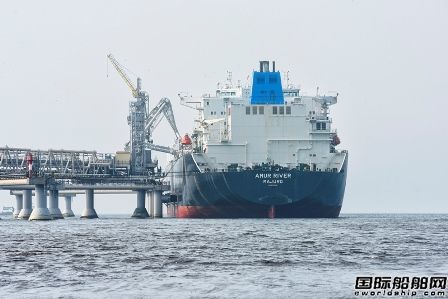
After the EU initiated sanctions against Russia, the German government has officially confiscated three large liquefied natural gas (LNG) carriers leased by three Russian companies. This action can be described as seizing the ships.
Greek shipowners are helpless! The German government has seized three LNG ships leased by Russia.
US-listed Greek shipowner Dynagas LNG Partners recently disclosed that three LNG vessels previously leased to Russia have been taken over by the German government.
The company stated in its latest performance report that since the German government has gained control of GAZPROM Germania, the German subsidiary of Gazprom, the LNG carrier contracts for the "Amur River", "Ob River", and "Clean Energy" have been under the indefinite control of the German government since April 4th.
According to International Ship Network, these three ships were originally leased to Gazprom with lease terms extending to 2026 and 2028. They were operated by Gazprom Marketing & Trading Singapore (GMT Singapore), and GAZPROM Germania is the indirect parent company of GMT Singapore. GAZPROM Germania operates key energy infrastructure in Germany and was taken over by the German government after the outbreak of the Russo-Ukrainian conflict.

Clarksons' data shows that the "Amur River" (built in 2008), "Ob River" (built in 2007), and "Clean Energy" (built in 2007) are all 149,700 cubic meter LNG carriers. In addition to these three LNG carriers, Dynagas' fleet includes three 155,000 cubic meter LNG carriers built in 2013: the "Yenisei River", "Arctic Aurora", and "Lena River".
Among them, the "Yenisei River" and "Lena River" are currently leased to Yamal Trade and will serve the Russian Yamal LNG project for at least 11 years. The "Arctic Aurora" is leased to Equinor with a lease term extending to the first quarter of 2026.
Dynagas LNG stated in its financial report that the current US and EU sanctions have not had a material impact on the company's business, operations, or financial condition. The company's trading partners are currently complying with applicable US and EU rules and regulations and fulfilling their obligations as stipulated in their respective periodic lease agreements.
In the first quarter of this year, Dynagas LNG's net profit increased by 50% year-on-year to $23.9 million. The company stated that the full commercial and economic impact of the Russo-Ukrainian conflict is currently uncertain, and the company cannot guarantee that any further development of sanctions or escalation of the Russo-Ukrainian situation will not materially affect its business, financial condition, or business results.
Germany's gamble on gas! It wants to take measures to completely cut off Russian natural gas.

It is understood that before the outbreak of the Russo-Ukrainian crisis, nearly a quarter of the EU's energy came from natural gas, of which nearly half came from Russia. Most of the natural gas exported by Russia was transported to various European countries via pipelines. Since the outbreak of the Russo-Ukrainian war, the EU has followed the US in imposing sanctions on Russia. Many countries in Europe and the US have imposed economic sanctions on Russia, and Germany is also taking measures to reduce its dependence on Russian natural gas. Russia has also fought back, including raising the price of exported energy and imposing counter-sanctions. Among them, the Russian gas company responsible for transporting natural gas shut down some pipelines, including GAZPROM Germania, the German subsidiary of Gazprom.
To this end, the German parliament passed a new law to ensure energy supply, which includes the possibility of the government requisitioning key energy infrastructure and assets in an emergency. In other words, if the German government deems there to be a significant risk to energy suppliers, it can "nationalize" some energy companies and take over their energy production, transportation, and distribution.
This law is expected to come into effect in June, and the first entity it may apply to is a Russian refinery that originally belonged to Rosneft. Even before this law was passed, the German government had already taken steps to take over Gazprom's German subsidiary.
 It is understood that Germany aims to completely cut off Russian natural gas by mid-2024. Last year, 55% of the natural gas used in Germany came from Russian imports; this proportion has now fallen to 35%. The level of dependence has decreased significantly.
On June 1, Gazprom, Russia's largest energy giant, announced that it had completely cut off the supply of energy to Shell in Germany because they did not cooperate with the ruble payment policy. This means that Germany has become the sixth country after Denmark to have its gas supply (partially) cut off by Russia, but German media claim that the impact is not large because the gas supply contract between Gazprom and Shell only has an annual volume of 1.2 billion cubic meters. The German government spokesperson stated that their domestic supply is still guaranteed, and further developments need to be monitored.
Related News

Address: No. 6, Xingyuan Avenue, Rucheng Street, Rugao City, Jiangsu Province
Tel: 86-513-87268999、86-513-7268666
Fax: 86-513-87268998
Email: info@ntlw.com
WeChat:15335077201

WeChat Official Account
Video account
Douyin account
Copyright © 2025 Nantong Liwei Machinery Co., Ltd.丨Powered by:www.300.cn丨SEO